In "A Woman Perpetually Falling" it talked about Bach-y-Rita and his discoveries regarding the brain and showed us one particular case he treated. Cheryl Schlitz has struggled with a faulty vestibular apparatus for five years and can't figure out how to resolve it. Not until she meets with Bach-y-Rita and wears a hat that sends her brain signals from an artificial vestibular apparatus. This is considered a neuroplastic miracle because the tingling sensations on her tongue are somehow finding their way to the brain area that deals with balance. This device could help not only people damaged by gentamicin but also the elderly. With much more usage, Cheryl is able to stay upright and help recover her vestibular function. This is just one example of Bach-y-Rita's discoveries regarding the human brain but he has struggled to come this far with his inventions. People have always viewed the brain as made up of different parts that each perform a specific function and one area can never do the work of another. But, Paul Bach-y-Rita rejected all these ideas and believes in "sensory substitution". He states that all our sense receptors translate into different electrical patterns sent to our nerves and these patterns are the universal language within our brain. Any part of the cortex is able to process whatever electrical signal is sent, so it meant our brain was not so specialized after all.
1. "An unspoken and yet profound aspect of our well-being is based on having a normally functioning sense of balance"
It is surprising how much we take granted of our sense of balance. Such important part of our body can have such a huge impact of our lives but rarely do we acknowledge it. It is just another part of our body that we don't realize its' role until it is gone or has a defect.
2. "She has almost no natural sensors. For the past twenty minutes we provided her with an artificial sensor. But the real miracle is what is happening now that we have removed the device, and she doesn't have either an artificial or a natural vestibular apparatus. We are awakening some kind of force inside her." It is amazing how providing her with an artificial vestibular apparatus has an instant impact on her as expected, but the aftermath is even more shocking. The brain is able to be stimulated and continue with a lasting effect. For her, this is so effective for her to try living like a normal person even though she has no natural or artificial vestibular apparatus.
3. "Our senses have an unexpectedly plastic nature, he discovered, and if one is damaged, another can sometimes take over for it, a process he calls "sensory substitution"
The human body is so versatile and can change so quickly to adapt to a new situation that we can't see physically. There are so many senses in our body yet they are able to adapt to a situation and react in a way that is so beneficial.
Monday, February 13, 2017

Thursday, February 9, 2017
Clay Brain
We made a clay model of the brain in class today. We took different color play-doh and shaped them into different parts of the brain. Then, we made a key of the different parts and labeled them. This activity really helped me visualize the different parts of the brain and allowed me to learn the names of each part.


Wednesday, February 8, 2017
The Woman With A Hole in Her Brain
A woman at age 24 finally realizes that a large part of her brain is missing. She finally resolved her unstable walking and incoherent speech from a young age due to the missing cerebellum. She is just one of nine people known to have part of their brain missing since most people die at a young age. Typically, problems with the cerebellum will lead to severe mental impairment, movement disorder, epilepsy, or fatal build-up of fluid in the brain. In the case of this woman, she has very mild symptoms which show how compatible our brain is.
The occipital lobe is responsible for visual perception. If there is damage to it, it could lead to loss of visual capability, difficulties with movement, an inability to identify colors, involuntary eye movements, and fine and gross motor skill difficulties. Sometimes, the person can even experience severe vision loss or total blindness. A person can live without an occipital lobe but there would be consequences involving visual deficits as a result. No other parts of the brain could take over this lobe as it is so unique in its different functions.
The occipital lobe is responsible for visual perception. If there is damage to it, it could lead to loss of visual capability, difficulties with movement, an inability to identify colors, involuntary eye movements, and fine and gross motor skill difficulties. Sometimes, the person can even experience severe vision loss or total blindness. A person can live without an occipital lobe but there would be consequences involving visual deficits as a result. No other parts of the brain could take over this lobe as it is so unique in its different functions.
Wednesday, February 1, 2017
Unit 5 Reflection
In this unit, we mostly focused on the digestive system, metabolism, endocrine and lymphatic system. The 6 basic functions of our digestive system are ingestion, secretion, mixing, digesting and absorption. From the alimentary canal all the way to the anal cavity they each take part in a unique way. Food starts off in the mouth where the tongue helps to change it into a bolus. Then, it travels from the pharynx to the esophagus where peristalsis helps move it to the stomach. The food then turns into chyme and the protein is starting to get digested. The small intestine and the accessory organs help to absorb nutrients and break down certain parts of the food. The large intestine then dries out indigestible food which leaves through the anus. We did a lab on the digestive system where we approximately measure how long it is. It was pretty shocking to see how long our digestive system really is considering the amount of space that we have and how it can fit. Then, we learned about our metabolism and how our body uses different sources of energy for each part. There are 3 different states that our body goes through after eating a meal. The fed, fasting and starvation state. It is really interesting how our body uses it different sources of energy and counts on different backup solutions in times of desperation.
An important hormone we learned about was insulin. An irregularity in the body when it comes to insulin is diabetes. It is the most common endocrine disorder within the US and there are 2 types. Type 1 typically occurs in children and is where one does not produce any insulin and requires insulin shots. Type 2 is way more common and usually begins with insulin resistance which leads to the body not being able to respond to the insulin produced.
The endocrine system controls everything involved in movement & physiological equilibrium. The endocrine glands include the pituitary, posterior lobe, adrenal medulla, adrenal cortex, pancreas, gonads, kidneys, anterior lob, thyroid, and parathyroid. Each of these play an essential role in secreting hormones that are responsible different parts of the body.
The major functions of the lymphatic system include immunity, lipid absorption, and fluid recovery. Lymph flows within lymphatic vessels and contains lymphocytes. Lymph capillaries allow interstitial fluid to flow in and out. Lymph nodes are rather important as they filter lymph, trap foreign substance which are then destroyed by immune cells.
This unit was rather different compared to the other units because I had minimal knowledge regarding any of the information we learned. There are so many different hormone and glands that are involved in very specific roles and can be confusing at times. But, the more I review the information the more I am able to absorb in the information and actually understand it. Considering the fact that it is the second semester of this class, my studying skills have definitely improved and makes learning and understanding new information much easier. This unit, we read many different articles regarding metabolism, diabetes and the endocrine system. One thing that I found really interesting was how strength training can actually help your metabolism in the long run. Also, I learned how there are many factors that contribute to each person's metabolism. I have always thought that a person's metabolism was determined by genetics and certain people were either lucky or not.
For my New Year Goals, I have been trying my hardest to stick to them. I definitely hit an all time low with my motivation at the beginning of the semester but it had definitely picked up in the past two weeks. I have been trying to not procrastinate as much and actually try to be as productive as possible. As with my second goal, I have been doing pretty well and have been expanding my exercise routine. Although there have been a few setbacks like getting sick and the rainy weather I will definitely try to resume to normal as soon as possible.
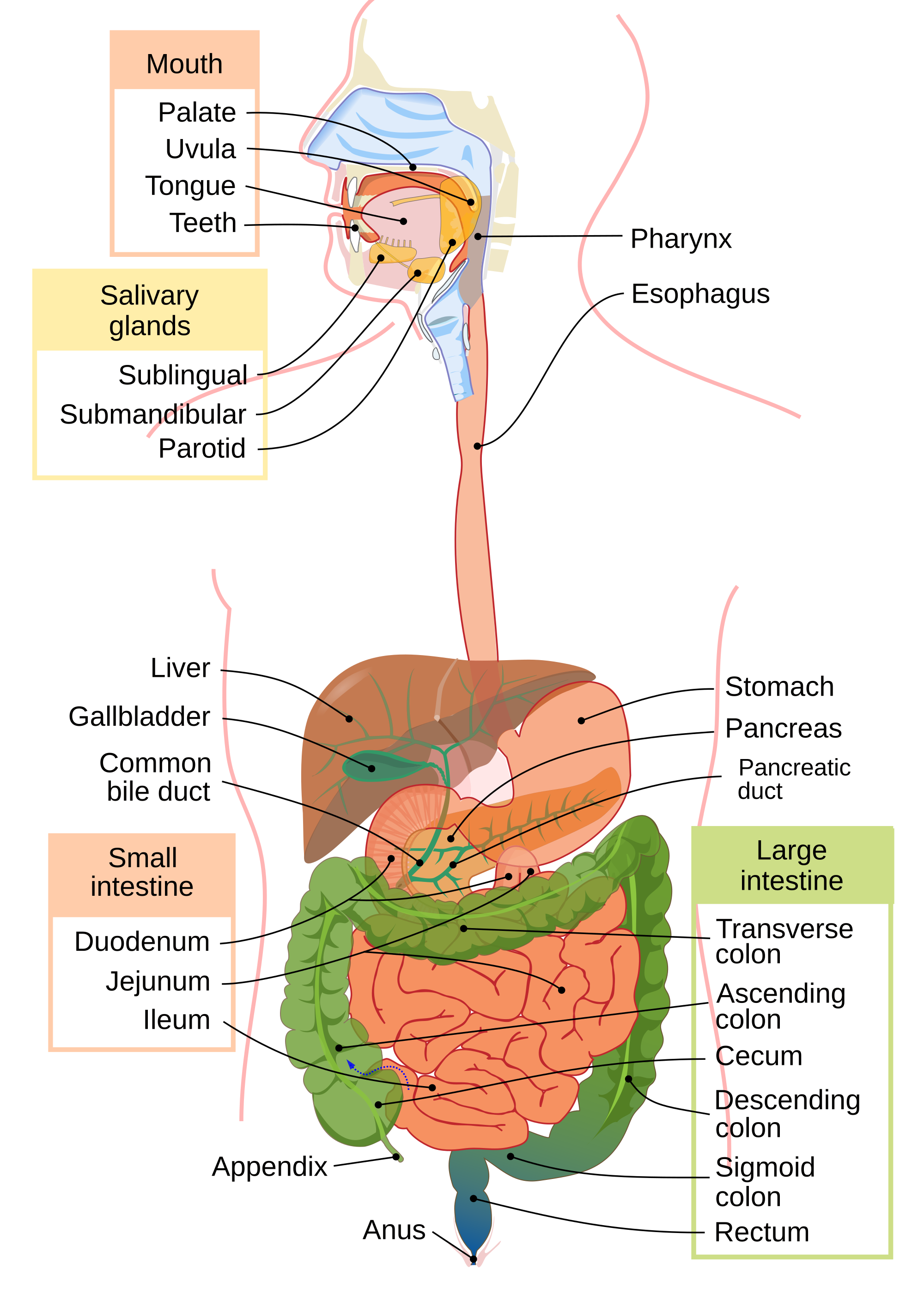 |
| Digestive System |
An important hormone we learned about was insulin. An irregularity in the body when it comes to insulin is diabetes. It is the most common endocrine disorder within the US and there are 2 types. Type 1 typically occurs in children and is where one does not produce any insulin and requires insulin shots. Type 2 is way more common and usually begins with insulin resistance which leads to the body not being able to respond to the insulin produced.
The endocrine system controls everything involved in movement & physiological equilibrium. The endocrine glands include the pituitary, posterior lobe, adrenal medulla, adrenal cortex, pancreas, gonads, kidneys, anterior lob, thyroid, and parathyroid. Each of these play an essential role in secreting hormones that are responsible different parts of the body.
 |
| Endocrine System |
The major functions of the lymphatic system include immunity, lipid absorption, and fluid recovery. Lymph flows within lymphatic vessels and contains lymphocytes. Lymph capillaries allow interstitial fluid to flow in and out. Lymph nodes are rather important as they filter lymph, trap foreign substance which are then destroyed by immune cells.
This unit was rather different compared to the other units because I had minimal knowledge regarding any of the information we learned. There are so many different hormone and glands that are involved in very specific roles and can be confusing at times. But, the more I review the information the more I am able to absorb in the information and actually understand it. Considering the fact that it is the second semester of this class, my studying skills have definitely improved and makes learning and understanding new information much easier. This unit, we read many different articles regarding metabolism, diabetes and the endocrine system. One thing that I found really interesting was how strength training can actually help your metabolism in the long run. Also, I learned how there are many factors that contribute to each person's metabolism. I have always thought that a person's metabolism was determined by genetics and certain people were either lucky or not.
For my New Year Goals, I have been trying my hardest to stick to them. I definitely hit an all time low with my motivation at the beginning of the semester but it had definitely picked up in the past two weeks. I have been trying to not procrastinate as much and actually try to be as productive as possible. As with my second goal, I have been doing pretty well and have been expanding my exercise routine. Although there have been a few setbacks like getting sick and the rainy weather I will definitely try to resume to normal as soon as possible.
Subscribe to:
Comments (Atom)