The white blood cell is a very important cell in the human body. Without it, there would be no line of defense in our body and we would get sick very easily, which would be detrimental to our health. There are many types of white blood cells and eosinophil is just one of them. Eosinophil is a type of granulocyte and a specialized cell of the immune system. They are about three times the size of a red blood cell.

They do not have the same organelles as the typical eukaryotic cell as they have a two-lobed nucleus and a cytoplasm filled with large granules that contain digestive enzymes.
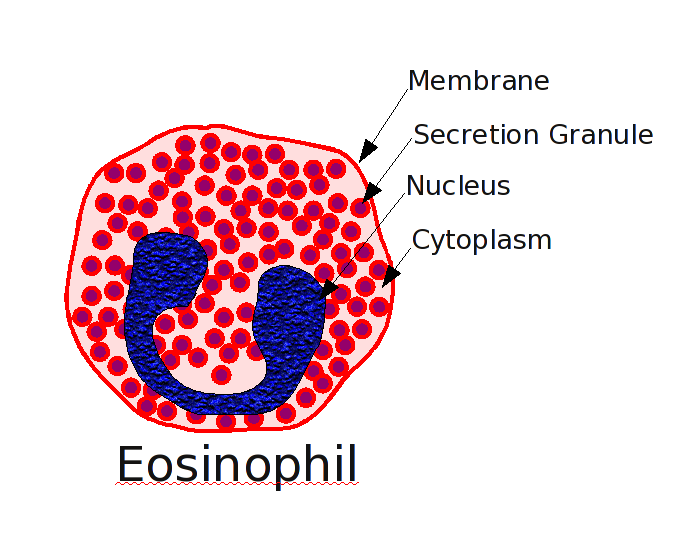
Image: "Eosinophil." Wikipedia. Wikimedia Foundation, n.d. Web. 06 Sept. 2016.
"File:Eosinophil.png." Wikipedia Commons, 24 Jan. 2006. Web. 6 Sept. 2016.
Text:
Vass, Laslo. "Eosinophils: Definition & Function." Study.com. Study.com, n.d. Web. 06 Sept. 2016.
Paxton, Steve. "White Blood Cells." Histology Guide | Blood. University of Leeds, n.d. Web. 06 Sept. 2016.
Underwood, Corinna. "Eosinophil Count." Healthline. Healthline Media, 11 Feb. 2016. Web. 06 Sept. 2016.

I like how your information covers a lot, but they way it is presented is concise. It makes it very knowledgeable and easy to grasp.
ReplyDeleteI really like the ratio of paragraphs to photos in your blog. Eosinophils, as well as other white blood cells, definitely keep us healthy and germ free.
ReplyDeleteI like how you not only explain what the organelles that are different from a typical cell, but you also show a picture of them.
ReplyDelete